
Farxiga vs Jardiance: Which SGLT2 Inhibitor Is Better?
If you are managing Type 2 diabetes, especially if you also have concerns about heart or kidney health, your doctor has likely mentioned a class of drugs called SGLT2 inhibitors.
Two of the biggest names in this class are Farxiga (dapagliflozin) and Jardiance (empagliflozin). They have revolutionized treatment because they don’t just lower blood sugar; they also offer significant protection for your heart and kidneys.
Why Compare These Two SGLT2 Inhibitors?
On the surface, Farxiga and Jardiance seem nearly identical. They are both once-daily pills, they have similar side effects, and they are often used for the same types of patients. However, there are subtle differences in their FDA approvals, clinical trial data, and insurance coverage that might make one a better fit for you than the other.
Key Differences at a Glance
| Feature | Farxiga (dapagliflozin) | Jardiance (empagliflozin) |
| Drug Class | SGLT2 Inhibitor | SGLT2 Inhibitor |
| Primary Use | Type 2 Diabetes | Type 2 Diabetes |
| Heart Failure Approval | Yes (HFrEF and HFpEF) | Yes (HFrEF and HFpEF) |
| CKD Approval | Yes | Yes |
| Standard Dose | 10 mg daily | 10 mg or 25 mg daily |
Mechanism of Action: How They Work
Farxiga and Jardiance share the exact same mechanism of action.
Normally, your kidneys filter glucose (sugar) out of your blood and then reabsorb most of it back into circulation. SGLT2 inhibitors block a specific protein in the kidneys (Sodium-Glucose Cotransporter-2) responsible for this reabsorption.
By blocking this protein, these drugs cause your kidneys to flush excess sugar out of your body through your urine. This process not only lowers blood sugar but also removes calories (aiding modest weight loss) and sodium (helping lower blood pressure).
Are there pharmacological differences?
While their chemical structures differ slightly, clinically, they work almost identically. There are no significant pharmacological differences that change how they are generally prescribed for diabetes management.
Approved Indications
A few years ago, the differences here were more distinct. Today, the FDA approvals for Farxiga and Jardiance have largely converged, making them strong competitors across the board.
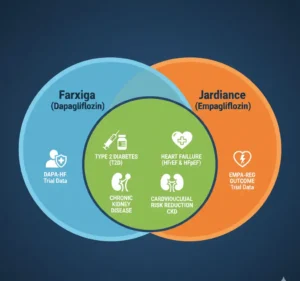
FDA-Approved Uses for Farxiga vs Jardiance
Both drugs are currently approved to:
-
Improve blood sugar control in adults with Type 2 diabetes (alongside diet and exercise).
-
Reduce the risk of cardiovascular death and hospitalization for heart failure in adults with heart failure (regardless of ejection fraction).
-
Reduce the risk of sustained eGFR decline, end-stage kidney disease, cardiovascular death, and hospitalization for heart failure in adults with Chronic Kidney Disease (CKD).
-
Reduce the risk of cardiovascular death in adults with Type 2 diabetes and established cardiovascular disease (or multiple risk factors).
Which has broader approvals?
Currently, they are essentially neck-and-neck. They are both powerhouses for treating the “cardio-renal-metabolic” axis.
Efficacy Comparison
When looking at how well they work, head-to-head data is limited, but we can compare results from their landmark pivotal trials.
-
HbA1c Reduction: Both drugs are highly effective at lowering A1c, typically reducing it by 0.7% to 1.0% when added to other therapies like metformin. There is no significant clinical difference in their ability to control blood sugar.
-
Weight Loss Effects: Because they cause you to urinate out calories (in the form of sugar), both drugs lead to modest weight loss—usually in the range of 2% to 4% of body weight.
-
Blood Pressure Reduction: Both cause a mild diuretic effect, leading to a slight decrease in systolic blood pressure (usually 3 to 5 mmHg).
-
Cardiovascular Outcomes & Heart Failure: This is where these drugs shine. The DAPA-HF trial (Farxiga) and EMPEROR-Reduced trial (Jardiance) both showed significant reductions in the risk of worsening heart failure or cardiovascular death. They are considered equally effective pillars of heart failure treatment.
-
Kidney Protection: Similarly, trials like DAPA-CKD (Farxiga) and EMPA-KIDNEY (Jardiance) demonstrated that these drugs significantly slow the progression of kidney disease.
Farxiga vs Jardiance Side Effects & Safety Profile
Because Farxiga vs Jardiance work the same way, their side effect profiles are virtually identical. The most common side effects are related to the increased sugar in the urine.
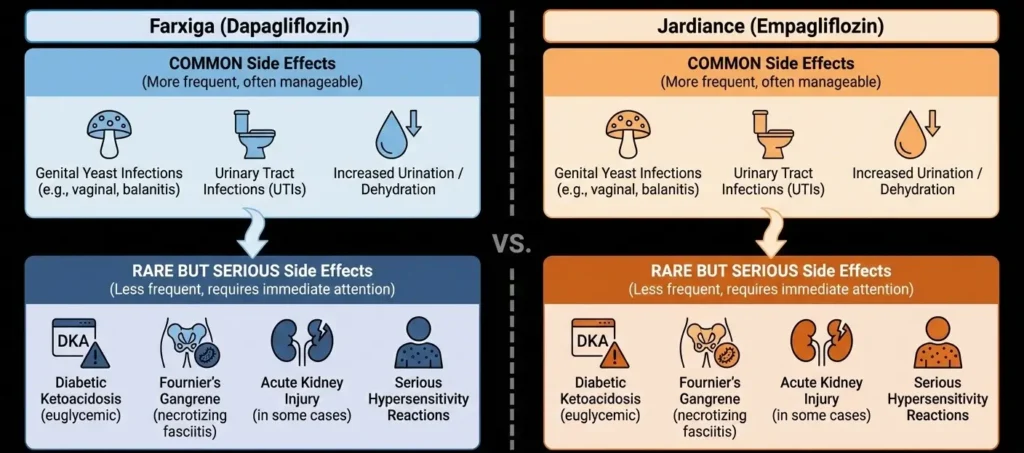
The Most Common Issue: Genital Mycotic Infections
By far the most common complaint is genital yeast infections in both men and women. Bacteria and yeast love sugar, and these drugs make your urine sugary.
-
Women: Vaginal yeast infections occur in roughly 5-10% of users.
-
Men: Balanitis (inflammation of the foreskin/head of the penis) occurs, particularly in uncircumcised men.
-
Good hygiene is critical to preventing these infections.
Other Risks
-
Urinary Tract Infections (UTIs): A slightly increased risk, though less common than yeast infections.
-
Volume Depletion & Hypotension: Because they act like mild diuretics, they can cause dehydration or low blood pressure, especially in elderly patients already on other diuretics (like furosemide or HCTZ).
-
Diabetic Ketoacidosis (DKA): A rare but serious condition where the blood becomes acidic. SGLT2 inhibitors can cause “euglycemic DKA” (DKA with normal blood sugar levels), which can be harder to diagnose. This is rare in Type 2 diabetes but is a major reason these drugs are generally avoided in Type 1 diabetes.
Is one safer? No data suggests one is significantly safer than the other.
Dosing & Administration
Both Farxiga vs Jardiance are easy-to-take oral tablets taken once in the morning, with or without food.
-
Farxiga (dapagliflozin): Usually started at 5 mg once daily, titrated up to a target dose of 10 mg once daily for maximum benefit.
-
Jardiance (empagliflozin): Usually started at 10 mg once daily. Some patients with diabetes may increase to 25 mg for additional glucose control, though the 10 mg dose is usually sufficient for heart and kidney benefits.
Renal Dosing: Both drugs depend on kidney function to work. If your eGFR (a measure of kidney filtration) drops too low, your doctor may discontinue them, though the threshold for using them safely in CKD has lowered significantly in recent years thanks to new trial data.
Patient Populations: Who Benefits Most From Farxiga vs Jardiance?
While excellent for blood sugar, these drugs are now guideline-recommended therapies even if blood sugar is controlled, specifically for patients with:
-
Heart Failure: Both are foundational treatments for HFrEF (reduced ejection fraction) and HFpEF (preserved ejection fraction).
-
Chronic Kidney Disease (CKD): To slow progression to dialysis.
-
Atherosclerotic Cardiovascular Disease (ASCVD): Patients who have already had a heart attack or stroke.
They are generally used with caution in very elderly patients due to the risk of dehydration and falls from low blood pressure.
Drug Interactions
The interaction profiles are very similar. The main culprits to watch for are:
-
Diuretics (Water Pills): Loop diuretics (like Lasix) or thiazides combined with Farxiga or Jardiance increase the risk of dehydration and low blood pressure. Your doctor may need to lower your diuretic dose.
-
Insulin or Sulfonylureas (e.g., glipizide, glimepiride): When combined with SGLT2s, the risk of hypoglycemia (low blood sugar) increases. Your doctor may lower the dose of your insulin or sulfonylurea.
Cost & Insurance Coverage Of Farxiga vs Jardiance
Neither Farxiga vs Jardiance is cheap. As brand-name medications, their cash price can exceed $500-$600 per month without insurance. Currently, there are no generic versions available in the United States.
Insurance is the deciding factor.
For most patients, the decision between Farxiga vs Jardiance comes down to which one is “preferred” on their insurance plan’s formulary. One might have a lower copay or require fewer prior authorization hurdles than the other.
Both manufacturers (AstraZeneca for Farxiga, Boehringer Ingelheim/Lilly for Jardiance) offer patient assistance programs and copay savings cards for eligible commercially insured patients.
Clinical Guidelines & Recommendations
Major medical organizations—including the American Diabetes Association (ADA), the American Heart Association (AHA), and Kidney Disease: Improving Global Outcomes (KDIGO)—strongly endorse SGLT2 inhibitors.
In current guidelines, Farxiga vs Jardiance are often listed interchangeably as preferred options for patients with T2D who also have heart failure or CKD regardless of their A1c level.
Decision-Making Framework
Since their efficacy and safety are so similar, how do you choose?
Choose Farxiga If:
-
Your insurance covers it better than Jardiance.
-
Your doctor has more experience prescribing it.
Choose Jardiance If:
-
Your insurance covers it better than Farxiga.
-
You need more potent blood sugar lowering and your doctor wants to utilize the higher 25mg dose (Farxiga tops out at 10mg).
When Either Is Appropriate: For the vast majority of patients looking for heart and kidney protection, either drug is an excellent choice.
Switching Between Drugs
Can you switch from Farxiga to Jardiance (or vice-versa)?
Yes. Because they are in the same drug class with the same mechanism, switching between Farxiga vs Jardiance is usually straightforward. This often happens due to changes in insurance coverage. You should never take both at the same time.
Frequently Asked Questions (FAQ)
-
Is Farxiga better than Jardiance for heart failure?
Current evidence suggests that Farxiga vs Jardiance are equally effective for treating heart failure (both reduced and preserved ejection fraction).
-
Which causes more weight loss, Farxiga vs Jardiance?
They are functionally equivalent regarding weight loss. Expect a modest loss of about 2-4% of body weight with either.
-
Can I take Farxiga and Jardiance together?
No. You should never take two SGLT2 inhibitors together. It increases the risk of side effects without added benefit.
-
Which is cheaper, Farxiga vs Jardiance?
The retail prices are similar. The cheapest option for you depends entirely on your specific insurance plan’s formulary.
Conclusion & Key Takeaways, Farxiga vs Jardiance.
The battle of Farxiga vs Jardiance is largely a draw. They are both breakthrough medications that have moved beyond just diabetes treatment to become essential tools for protecting the heart and kidneys.
The choice usually isn’t about which drug is clinically “better,” but rather which one is more accessible and affordable for you based on your insurance.
Final Recommendation: Talk to your doctor before deciding between Farxiga vs Jardiance. They will review your medical history, check your kidney function, and help you navigate insurance coverage to select the SGLT2 inhibitor that fits your life best.