
Farxiga vs Metformin: Which Diabetes Drug Is Actually Better?
Managing type 2 diabetes has evolved from simply “lowering blood sugar” to a comprehensive strategy for protecting your heart and kidneys. In 2026, the conversation often centers on two heavyweights: Metformin, the reliable “old guard” of diabetes treatment, and Farxiga (dapagliflozin), the versatile “new guard” with expansive benefits for the heart and kidneys.
Choosing between them or deciding to take them together can be complex. This guide provides a deep-dive comparison of Farxiga vs Metformin to help you and your doctor make an informed decision.
Drug Class & Mechanism of Action
While both Farxiga vs Metformin lower blood sugar, they do so through entirely different biological pathways.
Metformin: The “Glucose Gatekeeper”
Metformin belongs to the Biguanide class. It primarily targets the liver.
-
Liver: It reduces the amount of glucose your liver produces (gluconeogenesis).
-
Muscles: It increases insulin sensitivity, helping your muscles absorb glucose more efficiently.
-
Gut: It slows the absorption of glucose from the food you eat.
Farxiga: The “Glucose Excretor”
Farxiga is a Sodium-Glucose Cotransporter 2 (SGLT2) inhibitor. It targets the kidneys.
-
Kidneys: Normally, your kidneys reabsorb glucose back into the bloodstream. Farxiga blocks this process, allowing excess sugar to be flushed out through your urine.
-
The “Sugar Dump”: On Farxiga, you effectively “pee out” about 70 grams of sugar a day.
FDA-Approved Indications (As of 2026)
Metformin is primarily a diabetes drug, whereas Farxiga has transformed into a “cardio-renal-metabolic” powerhouse.
| Indication | Metformin | Farxiga |
| Type 2 Diabetes | Yes (First-line) | Yes |
| Heart Failure (HFrEF/HFpEF) | No | Yes (Reduces hospitalization/death) |
| Chronic Kidney Disease (CKD) | No | Yes (Slows progression) |
| Weight Management | Off-label only | Off-label (Significant benefit) |
| PCOS | Off-label only | No |
The Evolution of Treatment: Farxiga vs Metformin (From Herbal Roots to Heart Protectors)
When comparing diabetes treatments, it’s fascinating to see how we moved from a “one-size-fits-all” approach to the highly targeted, organ-protecting therapies we use today. The histories of Metformin and Farxiga couldn’t be more different.
Metformin: The Reliable “Old Guard”
Metformin has a surprisingly vintage backstory. Its roots trace back to a plant called French Lilac (Galega officinalis), which was used in folk medicine for centuries.
-
The Long Road: Although synthesized in the 1920s, Metformin was overshadowed by the discovery of insulin and sat on the sidelines until the 1950s.
-
The Gold Standard: It didn’t reach the U.S. market until 1995. Since then, it has reigned as the “gold standard” first-line therapy. Why? Because it’s incredibly effective, carries a low risk of hypoglycemia (low blood sugar), and—perhaps most importantly—it’s remarkably affordable. For decades, if you were diagnosed with Type 2 diabetes, Metformin was almost always your first stop.
Farxiga: The Modern Disruptor
Farxiga (dapagliflozin) is the high-tech newcomer that completely changed the playbook. When it received FDA approval in 2014, it was seen strictly as a glucose-lowering tool—a way to help the body “pee out” extra sugar.
-
The Paradigm Shift: Everything changed with landmark clinical trials like DAPA-HF and DAPA-CKD. These studies revealed something researchers hadn’t fully expected: Farxiga wasn’t just lowering sugar; it was actively shielding the heart and kidneys from damage.
-
Beyond Diabetes in 2026: This discovery was so profound that by 2026, Farxiga has evolved into a “cross-over” medication. It is now frequently prescribed to patients with heart failure or chronic kidney disease, regardless of whether they even have diabetes. It has effectively moved from being a “diabetes pill” to an “organ protection pill.”
The Big Takeaway: While Metformin remains the foundational “anchor” for blood sugar, Farxiga represents a new era where we treat the whole person—protecting the heart and kidneys while we manage the numbers.
Glycemic Efficacy: HbA1c Reduction
How well do they actually lower blood sugar?
-
Metformin: Potent. It typically lowers HbA1c by 1.0% to 1.5%. It is one of the most effective oral medications for strictly lowering blood sugar.
-
Farxiga: Moderate. It usually lowers HbA1c by 0.5% to 0.8%. Its primary value in 2026 is often viewed as its protective benefits rather than its raw glucose-lowering power.
Beyond Blood Sugar: Weight Loss & Blood Pressure
One reason Farxiga is gaining popularity is its “side benefits.”
Weight Loss
-
Metformin: Weight-neutral or slight loss. Most patients lose 2–5 lbs, often due to the initial stomach-related side effects.
-
Farxiga: Consistent weight loss. Because you are excreting calories (sugar) in your urine, most patients lose 4–7 lbs (roughly 2–3kg).
Blood Pressure
-
Metformin: No significant effect on blood pressure.
-
Farxiga: Acts like a mild diuretic. It typically lowers systolic blood pressure by 3–5 mmHg, which is beneficial for patients with hypertension.
Side Effect Face-Off: The Stomach vs. The Plumbing
When it comes to choosing between Metformin and Farxiga, the “deal-breakers” usually come down to which part of your body is more sensitive. While both are generally safe, they “protest” in very different ways.
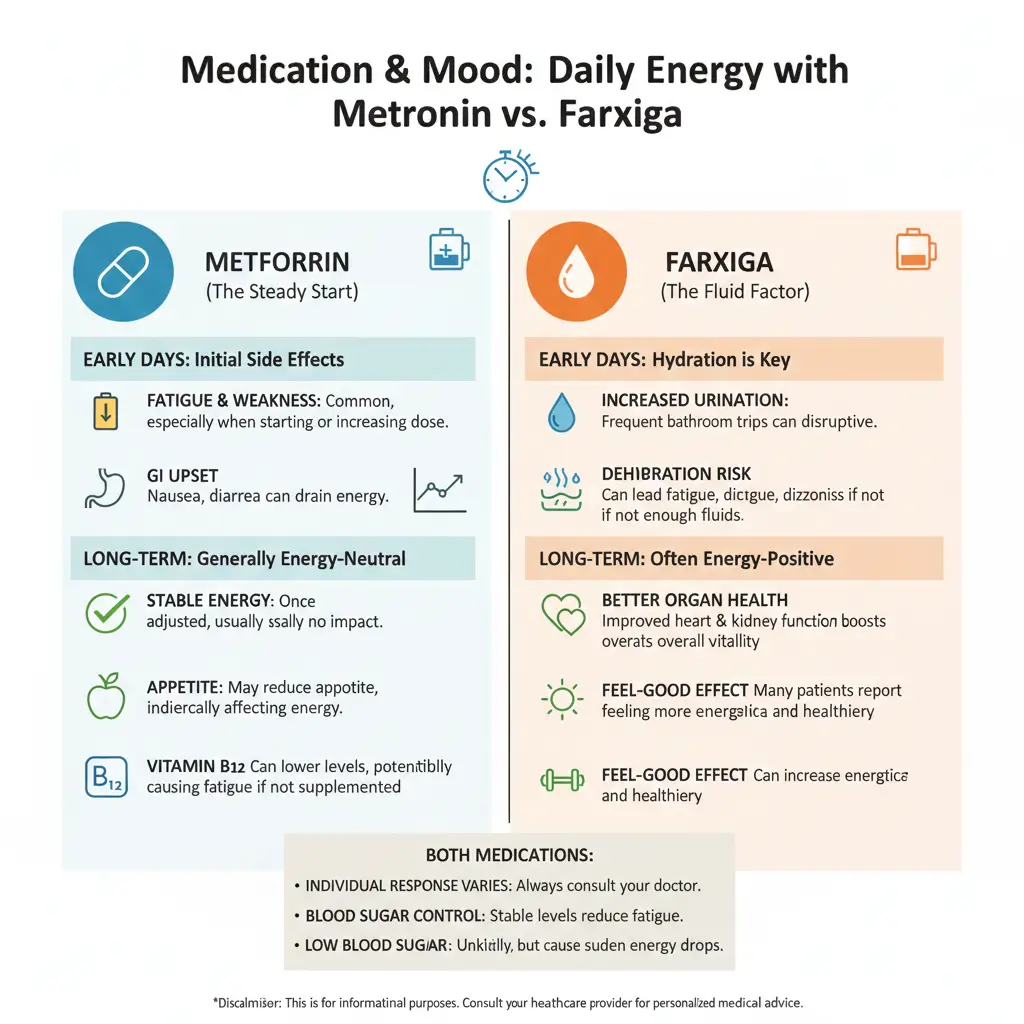
Metformin: The Digestive Challenge
Metformin is famous (or perhaps infamous) for its impact on the digestive tract. For most, these symptoms are a “rite of passage” that settles down after a few weeks, but for some, they can be persistent.
-
The “GI Transition”: Up to 50% of patients experience diarrhea, gas, or bloating when first starting. This is why doctors almost always start with a tiny dose and “titrate” up slowly.
-
The Metallic Tinge: A small number of people report a strange, metallic taste in their mouth—it’s harmless, but definitely annoying.
-
The B12 Stealth Issue: This is the one people often miss. Long-term Metformin use can interfere with how your body absorbs Vitamin B12. Over time, this can lead to fatigue or even nerve tingling.
Pro Tip: If you’re on Metformin long-term, ask your doctor to check your B12 levels once a year.
The Fix: Most GI issues are significantly reduced by using the Extended-Release (ER/XR) version of Metformin and always taking it with a full meal.
Farxiga: The Hydration & Hygiene Factor
Because Farxiga works by flushing sugar through your urine, its side effects are almost entirely centered on your “plumbing.”
-
The “Sugar Flush” (Infections): Bacteria and yeast love sugar. Because your urine becomes “sweet” on Farxiga, yeast infections occur in about 8% of women and can also affect uncircumcised men.
-
Increased Urination: You aren’t just losing sugar; you’re losing water. You will likely find yourself making more trips to the bathroom, especially during the first few days.
-
The “Head Rush” (Dehydration): If you don’t increase your water intake, you might experience orthostatic hypotension that dizzy, “lightheaded” feeling when you stand up too fast.
The Rare Red Flag (DKA): In very rare cases, Farxiga can cause Euglycemic Diabetic Ketoacidosis. This is a serious condition where your blood becomes acidic even if your blood sugar looks normal. If you feel nauseated, weak, or have trouble breathing, seek help immediately.
Side-by-Side Comparison
| Feature | Metformin | Farxiga |
| Primary Target | The Stomach / GI Tract | The Kidneys / Bladder |
| Main Nuisance | Diarrhea & Bloating | Frequent Urination |
| Long-Term Risk | Vitamin B12 Deficiency | Dehydration / Infections |
| Weight Impact | Weight Neutral (or slight loss) | Consistent Modest Loss |
| Best Mitigation | Take with food; use XR version | Drink extra water; maintain hygiene |
Safety & Serious Risks
In 2026, safety protocols for both Farxiga vs Metformin are well-established.
-
Metformin & Lactic Acidosis: A rare but life-threatening condition. The risk is highest in those with severe kidney or liver disease.
-
Farxiga & Ketoacidosis: It can cause euglycemic ketoacidosis, where your blood sugar is normal, but your blood is dangerously acidic. This is rare and often triggered by surgery, illness, or extreme low-carb diets.
-
Fournier’s Gangrene: An extremely rare but serious infection of the genital area associated with SGLT2 inhibitors like Farxiga.
Dosing & Administration
| Feature | Metformin | Farxiga |
| Typical Dose | 500mg, 850mg, 1000mg | 5mg or 10mg |
| Frequency | 1–2 times daily | Once daily (usually morning) |
| Timing | With meals (crucial for GI tolerability) | With or without food |
| Form | Large tablets or liquid | Small, film-coated tablets |
Cost & Insurance (The 2026 Landscape)
Cost is a major differentiator.
-
Metformin: Extremely cheap. Most generic versions cost under $10 for a 30-day supply, often $0 with insurance.
-
Farxiga: More expensive. However, in 2026, Farxiga was one of the first drugs selected for Medicare Price Negotiation. The negotiated price has made it significantly more accessible, though still more expensive than generic Metformin.
-
Generics: While authorized generics (like Prasco’s) exist, wide-scale generic competition for all indications is still evolving due to complex patent landscapes extending toward 2028.
Kidney Function Requirements (eGFR)
Both drugs are cleared or affected by the kidneys, so your “eGFR” (estimated Glomerular Filtration Rate) matters.
-
Metformin: Generally safe if eGFR is >45. If it drops between 30–45, the dose is halved. If eGFR <30, Metformin is discontinued.
-
Farxiga: Used for kidney protection down to eGFR 25. However, its ability to lower blood sugar diminishes as kidney function drops; at very low eGFRs, it is used for kidney/heart protection, not glucose control.
Cardiovascular Benefits
This is where Farxiga shines.
-
Metformin: Has a “neutral to slightly positive” effect on heart health. It is considered “cardio-safe.”
-
Farxiga: Proactive protection. It is a cornerstone treatment for Heart Failure (both with reduced and preserved ejection fraction), significantly reducing the risk of hospitalization.
2026 ADA Guidelines: Which is “First-Line”?
For decades, Metformin was the undisputed first choice. As of the 2026 ADA (American Diabetes Association) Standards, the choice is now personalized:
-
Metformin is still first-line for most “uncomplicated” type 2 diabetes.
-
Farxiga (or other SGLT2 inhibitors) is recommended first-line (even before Metformin) for patients who already have:
-
Heart Failure
-
Chronic Kidney Disease
-
Established Cardiovascular Disease (Atherosclerosis)
-
Combination Therapy (The “Perfect Pair“?)
Because they work through different mechanisms, Farxiga vs Metformin are frequently used together. In fact, they are often combined into a single pill called Xigduo XR.
Why combine them?
-
Synergy: Metformin stops the liver from making sugar; Farxiga helps the kidneys get rid of it.
-
Weight Loss: Both support weight management.
-
Low Hypoglycemia Risk: Neither drug usually causes “lows” (hypoglycemia) when used on their own.
Patient Experience & Quality of Life
Review data from 2025–2026 shows a split in patient satisfaction:
-
Metformin users often struggle with the “pill burden” (large tablets) and the initial 2-week “stomach flu” feeling. Once adjusted, satisfaction is high.
-
Farxiga users love the once-daily small pill and the weight loss, but some are frustrated by the frequent bathroom trips and the risk of yeast infections.
Decision-Making Framework: Which is Right for You?
Choose Metformin If…
-
Cost is your primary concern.
-
You need significant HbA1c reduction (e.g., your A1c is >8.5%).
-
You have a history of frequent UTIs or yeast infections.
-
You don’t have heart or kidney disease.
Choose Farxiga If…
-
You have heart failure or kidney disease.
-
Weight loss is a major goal of your therapy.
-
You have a history of high blood pressure.
-
You cannot tolerate the stomach side effects of Metformin.
Frequently Asked Questions Farxiga vs Metformin (FAQ)
Q: Can I switch from Metformin to Farxiga?
A: Yes, many patients do if they can’t tolerate Metformin’s GI side effects or if they develop heart/kidney issues.
Q: Does Farxiga cause hair loss?
A: While not a common clinical side effect, some user reviews mention it. Clinical trials do not currently list hair loss as a significant side effect.
Q: Is there a generic for Farxiga?
A: As of 2026, “authorized generics” are available, but they are not yet as inexpensive as traditional generics like Metformin.